
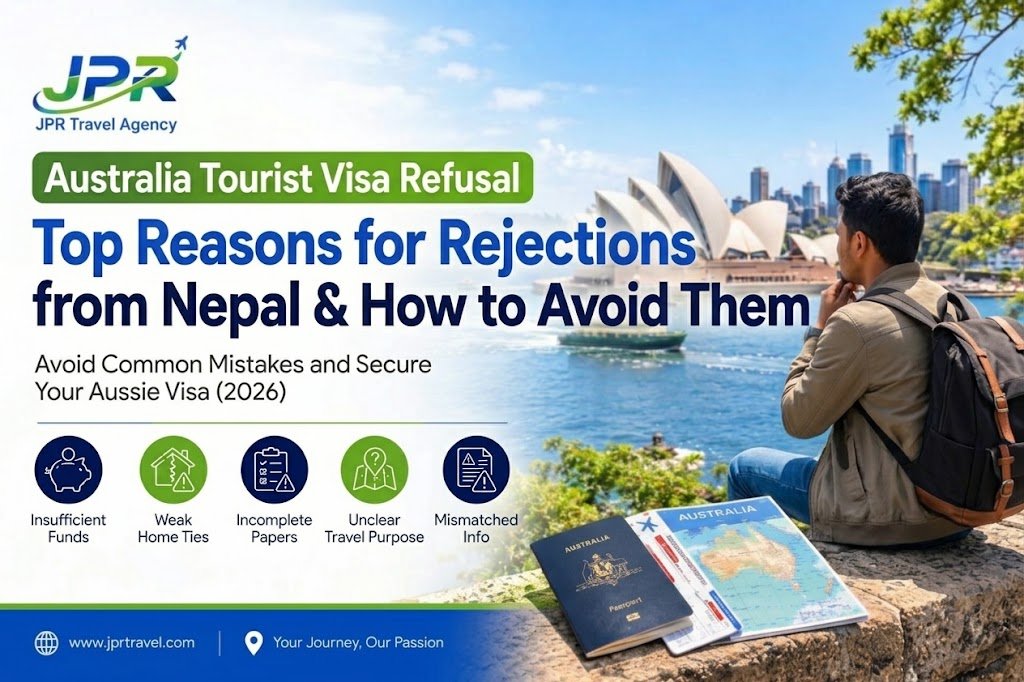
Australia is a dream destination for many Nepalese, whether it’s for exploring the Great Barrier Reef, experiencing the vibrant streets of Melbourne, or visiting family members studying abroad. However, applying for an aus tourist visa(Subclass 600) can be a highly stressful and confusing process. Nepal falls into a high-scrutiny category for visa assessments, meaning the Department of Home Affairs evaluates applications with a magnifying glass.
Many hopeful travelers are left heartbroken when they receive a refusal letter citing “Clause 600.211.” If your australian visit visa was recently rejected, or if you want to ensure your very first application is flawless, understanding the common pitfalls is crucial.
Much like our popular guide on Schengen Visa Rejection Reasons in Nepal, this post breaks down exactly why Subclass 600 applications from Nepal are denied and provides actionable steps to secure your visa grant.
Top Reasons for Australian Tourist Visa Rejection from Nepal
The Subclass 600 visa is a temporary visa, and the immigration officer’s primary job is to ensure you will actually leave Australia before your visa expires. Here are the most common reasons they might doubt your intentions:
1. Weak Ties to Nepal (Failing Clause 600.211)
Clause 600.211 of the Migration Regulations is the legal provision behind the vast majority of visitor visa refusals. It is the Genuine Temporary Entrant (GTE) requirement.
The Pitfall: If you cannot prove that you have a compelling reason to return to Nepal, your visa will be denied. A young, unmarried applicant with no stable job or property is often viewed as a high risk for overstaying.
The Solution: You must provide solid evidence of “incentives to return”. This includes a strong employment letter granting you approved leave, business registration documents (if you are an entrepreneur), university enrollment letters, or property valuation certificates (Lalpurja). Strong family ties in Nepal, such as a spouse or children staying behind, also serve as excellent proof.
2. Insufficient or Unverified Financial Proof
Australia is an expensive country, and the Department of Home Affairs wants to know you can afford your stay without resorting to illegal work.
The Pitfall: Depositing a massive lump sum of money into your bank account just a week before printing your statement is a massive red flag. Case officers call this “unverified funds”.
The Solution: Provide itemized personal bank statements covering the last 3 to 6 months that show a natural, genuine transaction history. For a standard short stay, a liquid balance equivalent to AUD 3,000 to AUD 5,000 is generally recommended. Additionally, include salary payslips, tax clearance certificates, and audited accounts to prove the source of your funds.
3. Improper or Fraudulent Documentation
Providing fake documents is the absolute worst mistake you can make. It will not only result in an immediate rejection but can also lead to a 3-year ban (Public Interest Criterion 4020) from entering Australia.
The Pitfall: Submitting bogus hotel bookings, fake tax records, or fabricated employer letters.
The Solution: Only submit 100% genuine, verifiable documents. If you are unsure about the paperwork required for international travel, read our guide on Must-Know Things Before Traveling Abroad. Furthermore, all non-English documents (like Nepali relationship certificates) must be translated into English by a certified Notary Public.
4. Vague Itinerary and Blank Passports
If you have a completely blank passport and are applying for a month-long holiday in Sydney with no clear itinerary, the case officer will likely doubt that you are a genuine tourist.
The Solution: Build your travel history first by visiting accessible visa-free or e-visa destinations. Provide a realistic, day-by-day travel itinerary that makes logistical and financial sense.
How to Write a Strong Statement of Purpose (SOP) / Cover Letter
Your Cover Letter is the only chance you get to “speak” directly to the Australian visa officer. A well-crafted letter can tip the scales in your favor, while a weak one can lead to a tourist visa australie rejection.
Ensure your Cover Letter covers the following pillars:
Exact Purpose of Visit: Are you going for sightseeing, or to attend a family member’s graduation? Be specific.
Financial Sponsorship: Clearly explain who is paying. If a family member in Australia is sponsoring you, attach their bank statements, invitation letter, and proof of their PR/Citizenship status.
Reasons to Return: Explicitly state your commitments in Nepal. (e.g., “I must return to Kathmandu by November 15th to resume my role as Senior Accountant at XYZ Corp.”)
Acknowledgment of Conditions: Mention that you are fully aware of visa conditions, specifically Condition 8101 (No Work Allowed), and intend to respect Australian laws.
Cover Letter: Quick Comparison
| Weak SOP / Cover Letter | Strong SOP / Cover Letter |
|---|---|
| A generic three-line paragraph | Structured with clear headings and bullet points |
| Leaves out specific travel dates | Provides exact flight dates and day-by-day plans |
| Hides previous visa rejections | Honestly addresses and explains past refusals |
How JPR Travel Can Minimize Your Rejection Risks
Navigating the ImmiAccount portal, figuring out biometric appointments at VFS Global in Kathmandu, and translating civil documents can be incredibly overwhelming. As a trusted Visit Visa Consultancy in Nepal, JPR Travel provides professional, end-to-end assistance to maximize your chances of approval.
Rigorous Document Vetting: We cross-check your bank statements, tax records, and civil documents to ensure there are no inconsistencies that could trigger a Clause 600.211 refusal.
Expert SOP Guidance: Our visa experts will help you draft a compelling, highly personalized cover letter that perfectly aligns with Australian immigration standards.
Flawless Application Lodgment: Through our International Tourist Visa Service, we handle the complex online lodgment, ensuring zero clerical errors.
Don’t let a minor paperwork mistake ruin your travel dreams. If you are researching agencies, check out our guide on How to Choose the Best Travel Agency in Nepal. Ready to get started on a flawless application? Contact JPR Travel today to book your visa consultation!
Frequently Asked Questions (FAQs)
1. How much bank balance is required for an Australian tourist visa from Nepal? While there is no official minimum fixed by the Department of Home Affairs, you should ideally show liquid funds of at least AUD 3,000 to AUD 5,000 (approx. 2.6 to 4.4 Lakhs NPR) for a short stay. This proves you can comfortably cover your flights, accommodation, and daily expenses.
2. What is Clause 600.211 in Australian visa rejections? Clause 600.211 is the Genuine Temporary Entrant (GTE) requirement. A rejection under this clause means the visa officer was not convinced that you truly intend to stay in Australia temporarily and return to Nepal.
3. Does my sponsor in Australia guarantee my visa approval? No. Even if your sponsor in Australia provides an invitation letter and proves they have millions in their bank account, you (the applicant) must still prove your own strong ties to Nepal.
4. Can I reapply immediately after my Australian visit visa is rejected? Yes, there is no official waiting period to reapply. However, it is highly recommended not to reapply until you can address the specific reasons for your refusal (e.g., providing better financial documents or stronger proof of employment).
5. Do I need to book my flights before applying for the visa? No. The Australian Department of Home Affairs explicitly advises applicants not to book non-refundable tickets until their visa is granted. A tentative travel itinerary is sufficient.
6. Do Nepalese citizens need to give biometrics for the Australia tourist visa? Yes. After submitting your application online, you will receive a letter requesting you to provide your biometrics (fingerprints and photo) at the VFS Global center in Kathmandu.