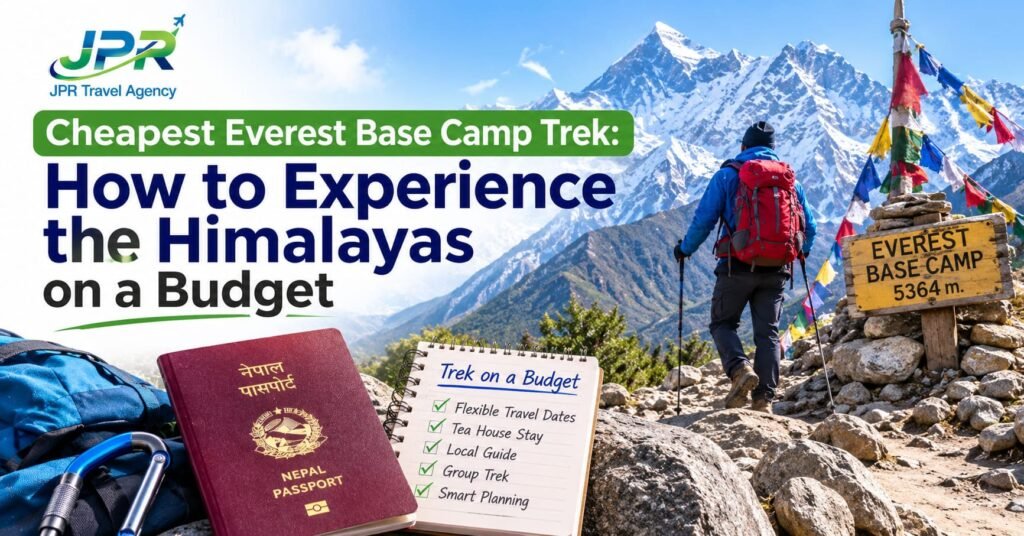
Completing the cheapest Everest Base Camp trek does not mean cutting corners on high-altitude safety or missing out on the Himalayan experience. With smart logistics, shared services, and disciplined daily spending, budget-conscious travellers can walk the exact same trail, stay in authentic Sherpa teahouses, and stand beneath Mount Everest for a fraction of the price of a luxury package.
While our comprehensive Everest Base Camp trek cost guide breaks down standard and full-service pricing across every comfort tier, this guide focuses specifically on planning a budget Everest Base Camp trek in 2026—showing you where to trim unnecessary expenses and where you must never compromise.
What Is the Cheapest Way to Trek to Everest Base Camp in 2026?
In November 2026 (using an approximate exchange rate of 1 USD = NPR 150), the realistic minimum budget for a safe 12-to-14-day trek falls into two practical ranges depending on your transport and support setup:
| Budget Trek Approach (Per Person) | Estimated 2026 Minimum Range |
|---|---|
| Overland Jeep + Independent / Shared Teahouse Setup | USD 780 – USD 950 (approx. NPR 117,000 – NPR 142,500) |
| Budget Group Trek / Ramechhap Flight + Shared Guide | USD 1,050 – USD 1,350 (approx. NPR 157,500 – NPR 202,500) |
What this minimum budget includes:
- Official local and national park trekking permits.
- Round-trip trailhead transport (shared jeep via Salleri/Surke or Ramechhap–Lukla flights).
- Basic twin-sharing teahouse accommodation for 11–13 nights.
- Three simple, high-energy local meals per day plus treated drinking water.
- A shared licensed guide or porter-guide (for the group/shared tier).
What is excluded:
- International flights to Kathmandu and your Nepal tourist visa (USD 30 for 15 days; USD 50 for 30 days).
- High-altitude travel and emergency helicopter evacuation insurance.
- Equipment rental, Kathmandu hotel stays, hot showers, Wi-Fi, device charging, snacks, and crew tips.
Emergency buffer: Every trekker should carry an additional USD 250 – USD 300 (NPR 37,500 – NPR 45,000) in reserve for weather-related flight delays in Lukla, extra lodge nights, or unexpected medical needs. Note that the lowest-cost overland or unguided setup requires extra travel days and high-altitude self-reliance, making it unsuitable for tight schedules or first-time hikers.
Budget Breakdown: Where Does Your Money Go?
Managing your ebc trekking cost requires distinguishing fixed government fees from flexible private service costs that vary by season, group size, and elevation.
1. Transportation: Flights vs Overland Jeeps
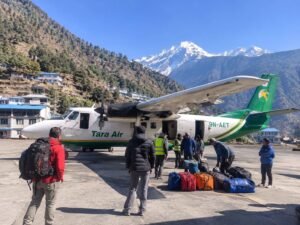 Fixed-wing flights are typically the largest single expense. A direct Kathmandu to Lukla flight costs foreign nationals approximately USD 254 – USD 257 (NPR 38,100 – NPR 38,550) one-way. During peak months, most flights operate via Manthali Airport in Ramechhap at around USD 199 (NPR 29,850) one-way, plus USD 25 – USD 35 (NPR 3,750 – NPR 5,250) for a shared 4-to-5-hour road transfer.
Travellers with extra time can cut transport costs by taking a shared jeep from Kathmandu to Salleri, Tham Danda, or Surke for NPR 4,500 – NPR 8,500 (approx. USD 30 – USD 57) per way. However, factor in 2 to 4 extra days of food and lodging across the round trip.
2. Budget Accommodation
Standard teahouses in lower villages (Phakding to Tengboche) charge NPR 500 – NPR 1,000 (USD 3.50 – USD 6.70) per night for a basic twin room, provided you eat dinner and breakfast at the same lodge. At higher elevations (Dingboche to Gorak Shep), rooms cost NPR 1,200 – NPR 2,500 (USD 8 – USD 16.70). Sharing a twin room with a trekking partner cuts your accommodation bill in half.
3. Food and Drinking Water
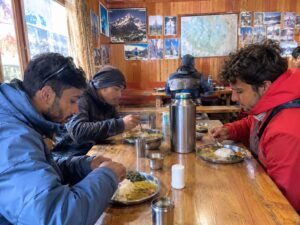 Expect to spend NPR 3,750 – NPR 6,000 (USD 25 – USD 40) per day on three filling meals. Ordering dal bhat (lentil soup, rice, and vegetable curry) for NPR 700 – NPR 1,400 (USD 4.70 – USD 9.30) is the best budget strategy because teahouses offer free refills on rice and lentils. Avoid buying plastic water bottles (NPR 150 – NPR 350+ per litre); instead, bring water purification tablets or a UV/filter bottle to save USD 50 to USD 100 over the trek.
4. Official Trekking Permits (Fixed Government Fees)
You cannot legally bypass required permits. For the classic Lukla route in 2026, two permits are mandatory (the old TIMS card is not required in Khumbu):
| Mandatory Permit (Foreign Nationals) | Official 2026 Fee |
|---|---|
| Sagarmatha National Park Entry Permit | NPR 3,000 (approx. USD 20; SAARC: NPR 1,500) |
| Khumbu Pasang Lhamu Rural Municipality Permit | NPR 3,000 (approx. USD 20; SAARC: NPR 2,000) |
Both permits total NPR 6,000 (approx. USD 40) per person and are payable in Nepalese Rupees cash at Monjo/Kathmandu and Lukla. (If walking in from Jiri, add the Gaurishankar Conservation Area Permit at NPR 3,000.)
5. Guides and Porters
While the Nepal Tourism Board enforced mandatory guide rules across many Nepali trails in 2023, the Khumbu Pasang Lhamu Rural Municipality still permits independent trekkers on the Everest Base Camp trail as of November 2026. Even so, hiring support significantly improves safety. A licensed guide costs USD 30 – USD 40 (NPR 4,500 – NPR 6,000) per day, a porter costs USD 20 – USD 28 (NPR 3,000 – NPR 4,200) per day (carrying up to 20–25 kg), and a porter-guide costs USD 28 – USD 32 (NPR 4,200 – NPR 4,800) per day. Splitting one guide and one porter between two to four trekkers reduces the per-person cost to just USD 12 – USD 20 per day.
6. Equipment Rental
Buying brand-new alpine gear adds hundreds of dollars to your trip. In Thamel (Kathmandu), you can rent a four-season down jacket and a -15°C to -20°C sleeping bag for NPR 150 – NPR 250 (USD 1 – USD 1.70) per item per day. Bring your own broken-in hiking boots, thermal base layers, and trekking socks from home.
7. Extra Trail Expenses and Insurance
Teahouses charge extra for ancillary services:
- Device charging: NPR 300 – NPR 1,000 (USD 2 – USD 6.70) per hour or per full charge.
- Hot showers: NPR 500 – NPR 1,000 (USD 3.30 – USD 6.70) in lower/mid villages.
- Wi-Fi (Everest Link): NPR 500 – NPR 1,000 (USD 3.30 – USD 6.70) per card.
- Travel Insurance: Budget USD 120 – USD 200 for a policy covering trekking up to 5,500–6,000 metres and emergency helicopter evacuation.
Best Ways to Save Money on the Everest Base Camp Trek
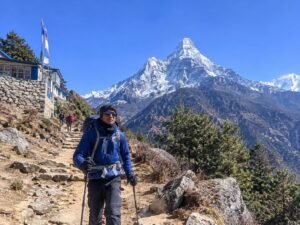 Follow these practical strategies to lower your trekking everest base camp price without sacrificing safety:
- Join a small group departure: Sharing a licensed guide and porters across 4 to 8 trekkers cuts staffing costs by up to 70% compared to a private solo tour.
- Compare package inclusions carefully: A cheap advertised tour that excludes permits, airport transfers, or return flights often ends up costing more than an honest all-inclusive budget package.
- Book Ramechhap flights or shared jeeps early: Securing your domestic flight in Nepal well ahead of peak departures prevents costly last-minute helicopter charters.
- Rent bulky cold-weather gear in Kathmandu: Renting down jackets, sleeping bags, and trekking poles in Thamel saves both luggage fees and retail expenses.
- Pack trail snacks and electrolytes from Kathmandu: Chocolate bars, nuts, and rehydration salts cost three to four times more in Gorak Shep than in Kathmandu supermarkets.
- Carry a high-capacity power bank (20,000 mAh+): Keeping your phone and camera charged in your sleeping bag at night avoids daily lodge charging fees.
- Use wet wipes above Namche Bazaar: Skipping paid hot showers at high altitude saves money and helps you avoid catching a chill in unheated bathrooms.
- Stick to vegetarian local meals: Meat must be carried up the mountain without refrigeration, making it expensive and risky for your stomach; vegetarian dal bhat, porridge, and garlic soup are cheaper, fresher, and safer.
- Withdraw enough NPR cash in Kathmandu: ATMs in Lukla and Namche Bazaar frequently run out of cash or charge steep foreign transaction fees.
Budget Trekking vs Expensive Trekking: What Is the Difference?
Understanding what separates a budget trek from a luxury package helps you decide where your money matters most:
| Feature | Budget vs Premium Trekking Comparison |
|---|---|
| Accommodation | Basic twin rooms with shared bathrooms vs luxury lodges (e.g., Yeti Mountain Home) with heated beds and en-suite baths |
| Transportation | Ramechhap fixed-wing flights or shared jeeps vs direct Kathmandu flights or private helicopter transfers |
| Group & Crew | Shared group (4–10 trekkers) or shared porter-guide vs private 1-on-1 senior guide and dedicated porters |
| Meals & Extras | Fixed one-main-course local meals and purified water vs open-menu dining, bakery stops, and unlimited hot showers |
| Overall Cost | Approx. USD 780 – USD 1,350 vs USD 2,500 – USD 5,500+ per person |
Paying more is worthwhile if you want heated bedrooms, private helicopter returns, or a fully flexible private schedule.However, for healthy hikers comfortable with simple mountain lodges, a budget arrangement delivers the exact same trails, viewpoints, and Sherpa hospitality.
What Should You Never Compromise on to Save Money?
Cutting costs in the wrong places can turn a dream trekking in Nepal adventure into an emergency:
- Required permits: Attempting to skip checkpoints risks heavy fines and immediate removal from the park.
- High-altitude evacuation insurance: A single emergency helicopter rescue from Gorak Shep or Pheriche costs USD 4,000 to USD 6,000+ out of pocket without proper coverage.
- Acclimatisation days: Never skip rest days in Namche Bazaar and Dingboche to save two nights of food and lodging; review our altitude sickness guide to understand why gradual ascent is essential.
- Calories and hydration: Undereating or drinking untreated water at 5,000 metres accelerates exhaustion and Acute Mountain Sickness (AMS).
- Proper footwear and thermal layers: Frostbite and severe blisters will end your trek prematurely.
- Emergency reserve funds: Bad weather in Lukla regularly grounds flights for 1 to 3 days.
Best Time to Do the Everest Base Camp Trek on a Budget
Seasonal timing affects flight availability, lodge demand, and daily spending. Learn more about route conditions in our complete Everest Base Camp trek guide.
- Peak Seasons (March–May and October–November): Offer the most stable weather and clearest views, making it easier to join shared group departures. However, teahouses fill up quickly, flights usually divert via Ramechhap,and lodge room rates remain firm.
- Shoulder Months (Late February, Late May, Late November–Early December): Trails are quieter and teahouse owners are often more flexible with room rates when you dine in their lodge.
- Off-Peak (Monsoon June–August and Mid-Winter January): While teahouse beds are easier to negotiate,monsoon clouds frequently cancel Lukla flights for days—wiping out any savings through extra hotel nights or helicopter rebookings—while winter brings extreme sub-zero temperatures requiring heavier gear.
Is a Budget Everest Base Camp Trek Worth It?
A budget Everest Base Camp trek is wholeheartedly worth it. The Himalayas do not charge extra for sunrise over Ama Dablam, prayer flags fluttering across Hilary Suspension Bridge, or evening conversations around a warm teahouse stove.By trading luxury upgrades for smart planning, shared logistics, and local meals, you experience the Khumbu region authentically and sustainably.
Final Budget Advice and Plan Your Trek with JPR Travel Agency
Keeping your ebc trekking cost low comes down to four essentials: booking transport early, sharing guide and porter expenses in a small group, eating nutritious local dal bhat, and carrying purified water and backup power.
Whether you want to join a cost-sharing group departure, arrange a licensed guide and Lukla flights, or build a custom low-cost itinerary, JPR Travel Agency helps trekkers experience Everest safely without hidden markups. Contact JPR Travel Agency today to discuss realistic 2026 budget options and start planning your trek.
Frequently Asked Questions
1. What is the cheapest way to trek to Everest Base Camp?
The cheapest practical way is either trekking independently (or with a partner sharing one porter-guide) using overland shared jeeps between Kathmandu and Salleri/Surke, or joining a shared budget group trek that splits guide, porter, and transfer costs while eating local meals and purifying your own drinking water.
2. How much does a budget Everest Base Camp trek cost in 2026?
As of November 2026, a realistic budget Everest Base Camp trek costs between USD 780 and USD 950 (approx. NPR 117,000 – NPR 142,500) for an overland/independent setup, or USD 1,050 to USD 1,350 (approx. NPR 157,500 – NPR 202,500) per person for a budget group trek including Ramechhap–Lukla flights, permits, basic teahouses, local meals,and a shared guide. Keep an extra USD 250–300 for emergencies.
3. Can I trek to Everest Base Camp without booking an expensive package?
Yes. Instead of booking a luxury all-inclusive package, you can book a budget group departure, hire only a local licensed guide or porter-guide and pay for teahouses and meals directly on the trail in NPR, or arrange transport and permits through a local agency like JPR Travel Agency.
4. How can I reduce the cost of the Everest Base Camp trek?
You can lower your expenses by flying via Ramechhap or taking a shared jeep to Surke, sharing twin rooms and guide/porter fees with other trekkers, eating filling local meals like dal bhat, using water purification tablets instead of bottled water, renting down jackets and sleeping bags in Kathmandu, and carrying a power bank.
5. Is joining a group trek cheaper than a private trek?
Yes. Joining a small group trek allows you to split fixed daily costs—including licensed guide wages (USD 30–40/day), porter wages (USD 20–28/day, shared between two trekkers), and ground transfers to Ramechhap—making it significantly cheaper per person than a private 1-on-1 trek.
6. What is the cheapest time to trek to Everest Base Camp?
Late shoulder periods (late February, late May, and late November to early December) often provide the best balance of lower teahouse demand and stable flight operations. While monsoon (June–August) and mid-winter (January) have low trail traffic, weather-related Lukla flight cancellations or extreme cold gear needs can actually increase your total spending.
7. Can I rent trekking equipment in Kathmandu instead of buying it?
Yes. Dozens of outfitters in Thamel, Kathmandu rent essential cold-weather gear—such as down jackets, four-season sleeping bags, crampons, and trekking poles—for approximately NPR 150 to NPR 250 (USD 1 to USD 1.70) per item per day, saving hundreds of dollars over buying new gear.