
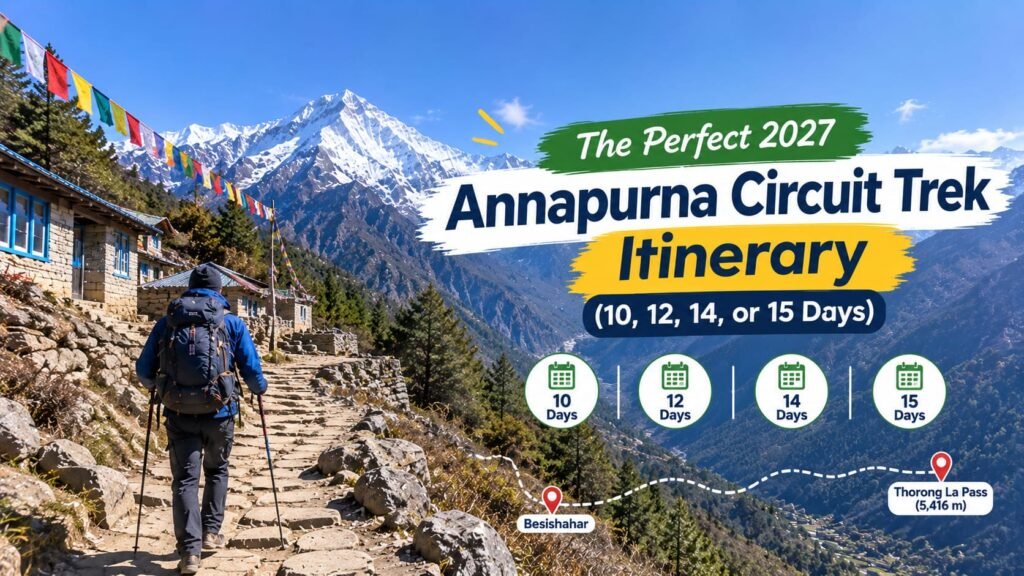
Most travellers should plan between 12 and 15 days for the Annapurna Circuit, though experienced hikers with tight schedules can complete a modified route in 10 days. Choosing the right annapurna circuit trek itinerary for 2027 depends on how you balance high-altitude acclimatisation, expanding road access, seasonal trail conditions, and your available vacation time.
Because motorable roads now reach deeper into the Marsyangdi and Kali Gandaki valleys, trekkers can customize where they start walking and where they take local 4WD transport. This guide compares realistic 10-day, 12-day, 14-day, and 15-day itineraries so you can select the safest schedule for your fitness and goals. For complete package details and general route overviews, visit our main Annapurna Circuit Trek page.
How Many Days Do You Need for the Annapurna Circuit Trek?
Historically a three-week expedition, modern trekking days in Nepal along the Annapurna Circuit route typically range from 10 to 15 days. Every itinerary in this guide uses the same Kathmandu-to-Kathmandu planning basis, meaning overland transfers at the start and end of the trip are included in the total day count:
- 10 days: A compressed schedule requiring 4WD transfers up to Dharapani or Chame and out from Muktinath or Jomsom, leaving zero buffer for delays.
- 12 days: A popular shorter route that preserves core walking stages from Dharapani to Muktinath while keeping one mandatory acclimatisation day in Manang.
- 14 days: A well-paced itinerary offering gradual elevation gain, scenic upper-valley trails, and a comfortable exit via Pokhara.
- 15 days: A flexible schedule with extra time for side hikes around Manang, cultural stops, and weather or transport contingencies.
No single duration suits everyone; your ideal choice depends on prior altitude experience and how much lower-valley trekking you wish to include.
Annapurna Circuit Trek Itinerary: 10 Days
An annapurna circuit 10 days schedule is only feasible by using 4WD jeeps to bypass the lower trails and driving out immediately after crossing the pass. While a 10 days annapurna circuit trek saves time, it is neither easier nor safer than longer versions: rapid initial elevation gain via vehicle demands strict attention to acclimatisation, and tight connections leave no margin for road blocks or high-pass weather delays.
- Day 1: Kathmandu (1,350 m) to Dharapani (1,860 m) via Besisahar (760 m) – Bus and shared 4WD jeep up the Marsyangdi Valley (8–10 hours drive).
- Day 2: Dharapani to Chame (2,670 m) – Trek through pine forests past Bagarchhap and Timang with views of Manaslu (5–6 hours walk).
- Day 3: Chame to Upper Pisang (3,300 m) – Follow the river past Bhratang apple orchards and the Paungda Danda rock face (5–6 hours walk).
- Day 4: Upper Pisang to Manang (3,540 m) – Trek the scenic upper trail via Ghyaru (3,730 m) and Ngawal for panoramic Annapurna views (5–6 hours walk).
- Day 5: Acclimatisation Day in Manang (3,540 m) – Active rest day with an acclimatisation hike toward Gangapurna Viewpoint or Praken Gompa (3–4 hours walk).
- Day 6: Manang to Yak Kharka (4,050 m) – Steady climb above the treeline through Tenki Manang and Gunsang (3–4 hours walk).
- Day 7: Yak Kharka to Thorong Phedi (4,525 m) or High Camp (4,880 m) – Short, rugged ascent along high cliffs to the pre-pass staging lodges (3–5 hours walk).
- Day 8: Cross Thorong La Pass (5,416 m) to Muktinath (3,800 m), drive to Jomsom (2,720 m) – Pre-dawn climb over the pass, long descent to Muktinath, and afternoon jeep to Jomsom (7–9 hours walk; 1 hour drive).
- Day 9: Jomsom to Pokhara (822 m) – Morning flight (approx. 25 minutes, seasonal) or overland jeep/bus down the Kali Gandaki Gorge (6–8 hours drive).
- Day 10: Pokhara to Kathmandu (1,350 m) – Tourist bus or highway transfer back to Kathmandu (6–8 hours drive).
Annapurna Circuit Trek Itinerary: 12 Days
Compared with the 10-day sprint, a 12 days annapurna circuit trek starts walking lower in the Marsyangdi Valley and splits the post-pass descent so you can walk from Muktinath to Jomsom via Kagbeni rather than rushing straight into a vehicle.
- Day 1: Kathmandu (1,350 m) to Jagat (1,300 m) via Besisahar – Highway bus to Besisahar and local jeep to Jagat (7–8 hours drive).
- Day 2: Jagat to Dharapani (1,860 m) – Walk along suspension bridges, waterfalls, and the steep stone staircase to Tal (5–6 hours walk).
- Day 3: Dharapani to Chame (2,670 m) – Ascend through oak and rhododendron forests to the Manang district headquarters (5–6 hours walk).
- Day 4: Chame to Upper Pisang (3,300 m) – Enter the drier upper valley beneath Annapurna II (5–6 hours walk).
- Day 5: Upper Pisang to Manang (3,540 m) – High-route trek via Ghyaru and Ngawal to Manang (5–6 hours walk).
- Day 6: Acclimatisation Day in Manang (3,540 m) – Morning acclimatisation hike and afternoon altitude lecture at the Himalayan Rescue Association clinic.
- Day 7: Manang to Yak Kharka (4,050 m) – Gradual alpine ascent to Yak Kharka (3–4 hours walk).
- Day 8: Yak Kharka to Thorong Phedi (4,525 m) – Trek past Ledar to the foot of the pass (3–4 hours walk).
- Day 9: Thorong Phedi to Muktinath (3,800 m) via Thorong La Pass (5,416 m) – Early climb over Thorong La and descent to the sacred Muktinath shrine (7–9 hours walk).
- Day 10: Muktinath to Jomsom (2,720 m) via Kagbeni – Trek through the arid Mustang landscape and medieval Kagbeni village (4–5 hours walk).
- Day 11: Jomsom to Pokhara (822 m) – Overland transfer via Beni or morning flight to lakeside Pokhara.
- Day 12: Pokhara to Kathmandu (1,350 m) – Return drive to Kathmandu (6–8 hours drive).
Annapurna Circuit Trek Itinerary: 14 Days
Planning an annapurna circuit trek 14 days schedule provides an ideal balance for most hikers. By starting the trek lower near Bhulbhule or Syange and adding a stop in the apple-growing village of Marpha or hot-spring town of Tatopani after the pass, your body adjusts more gradually to altitude while enjoying a richer cultural journey.
- Day 1: Kathmandu (1,350 m) to Syange (1,100 m) via Besisahar – Drive to Besisahar and continue by jeep to Syange (7–8 hours drive).
- Day 2: Syange to Dharapani (1,860 m) – Trek via Jagat and the cliffside trail into Tal (6–7 hours walk).
- Day 3: Dharapani to Chame (2,670 m) – Forested ascent along the Marsyangdi River (5–6 hours walk).
- Day 4: Chame to Upper Pisang (3,300 m) – Trek through pine woods and dramatic rock gorges (5–6 hours walk).
- Day 5: Upper Pisang to Manang (3,540 m) – High-trail walk via Ghyaru, Ngawal, and Braga Monastery (5–6 hours walk).
- Day 6: Acclimatisation Day in Manang (3,540 m) – Day hike toward Chongkor Viewpoint or Ice Lake (4,600 m) and overnight in Manang.
- Day 7: Manang to Yak Kharka (4,050 m) – Gentle ascent into high alpine pastures (3–4 hours walk).
- Day 8: Yak Kharka to Thorong Phedi (4,525 m) – Walk through Ledar to Thorong Phedi (3–4 hours walk).
- Day 9: Cross Thorong La Pass (5,416 m) to Muktinath (3,800 m) – Summit the high pass at dawn and descend to Muktinath (7–9 hours walk).
- Day 10: Muktinath to Marpha (2,670 m) via Jomsom – Walk down through Lubra or Kagbeni and Jomsom to the whitewashed Thakali village of Marpha (5–6 hours walk).
- Day 11: Marpha to Tatopani (1,190 m) – Drive or trek down the Kali Gandaki valley to relax in Tatopani’s natural hot springs (4–5 hours drive/walk).
- Day 12: Tatopani to Ghorepani (2,874 m) – Transfer to Sikha and trek through rhododendron forests to Ghorepani (4–5 hours combined).
- Day 13: Poon Hill (3,210 m) Sunrise, Trek to Nayapul, Drive to Pokhara (822 m) – Morning viewpoint climb, descend via Ulleri, and drive to Pokhara (5–6 hours walk; 2 hours drive).
- Day 14: Pokhara to Kathmandu (1,350 m) – Return overland transfer to Kathmandu (6–8 hours drive).
Annapurna Circuit Trek Itinerary: 15 Days
An annapurna circuit trek 15 days plan builds directly on the 14-day route by adding a second night in the upper Manang region or splitting the climb between Yak Kharka and High Camp. This extra day significantly improves Annapurna Circuit acclimatisation, permits a dedicated excursion to Ice Lake (Kicho Tal, 4,600 m) or Milarepa Cave, and acts as a vital buffer if heavy snow temporarily delays the pass crossing.
- Days 1–6: Follow Days 1–6 of the 14-day itinerary from Kathmandu to Manang (3,540 m), including the first acclimatisation day.
- Day 7: Second Exploration/Buffer Day in Manang (3,540 m) – Full-day acclimatisation trek to Ice Lake (4,600 m) or cultural visit to Braga and Khangsar villages, sleeping low in Manang.
- Days 8–15: Follow Days 7–14 of the 14-day itinerary over Thorong La Pass (5,416 m) through Muktinath, Marpha, Tatopani, Ghorepani Poon Hill, and Pokhara back to Kathmandu.
Important Places Along the Annapurna Circuit Route
Understanding the key hubs along the Annapurna trekking route helps you customize your stops:
- Besisahar (760–820 m) & Dharapani (1,860 m): Besisahar is the traditional gateway town, while Dharapani is today’s most common trailhead where trekkers leave the jeep road.
- Chame (2,670 m) & Upper Pisang (3,300 m): Chame serves as the administrative hub of Manang District with shops and hot springs; Upper Pisang marks the transition into the dry rain-shadow zone and the start of the scenic high trail via Ghyaru.
- Manang (3,540 m): The largest high-valley settlement, featuring bakeries, monasteries, and the Himalayan Rescue Association aid post.
- Yak Kharka (4,050 m) & Thorong Phedi (4,525 m) / High Camp (4,880 m): Essential high-altitude staging stops that break up the climb above 4,000 metres.
- Thorong La Pass (5,416 m), Muktinath (3,800 m), Jomsom (2,720 m) & Pokhara (822 m): After crossing the 5,416-metre pass, the trail drops sharply into the sacred pilgrimage town of Muktinath and the transport hub of Jomsom before finishing in lakeside Pokhara.
Because road access now connects Besisahar toward Manang and Muktinath to Beni, always ask your guide to follow the marked Natural Annapurna Trekking Trails (NATT) to stay on quiet footpaths away from vehicle dust.
Thorong La Pass and Acclimatisation
At 5,416 metres (17,769 feet), Thorong La Pass is the physical and physiological crux of the circuit. Oxygen levels at the summit are roughly half those at sea level, making gradual ascent non-negotiable. Never skip your rest day in Manang to squeeze the trek into a shorter timeframe, and ascend no more than 400 to 500 metres in sleeping elevation per day above 3,000 metres.
Trekkers typically depart Thorong Phedi or High Camp between 3:00 AM and 4:00 AM to cross the pass before strong late-morning winds develop, subject to real-time weather and local guide assessments. Read our comprehensive altitude sickness guide to learn how to recognise early Acute Mountain Sickness (AMS) symptoms—such as persistent headache, nausea, dizziness, or insomnia—and why immediate descent is critical if symptoms worsen. Every trekker must carry travel insurance covering high-altitude trekking up to 5,500 metres and emergency helicopter evacuation. If you prefer a lower-elevation introduction to the Himalayas, see our guide on what is the easiest trek in Nepal.
Which Annapurna Circuit Itinerary Should You Choose?
Selecting the right annapurna circuit itinerary comes down to balancing your time off work with your comfort at altitude:
| Itinerary | Best suited for |
|---|---|
| 10 days | Experienced, fit trekkers with strict time limits who accept long 4WD transfers and zero buffer days. |
| 12 days | Trekkers wanting a focused high-mountain crossing with proper Manang acclimatisation and minimal road walking. |
| 14 days | Most travellers seeking a balanced pace, lower-elevation warm-up days, and the Poon Hill extension. |
| 15 days | Hikers preferring maximum altitude safety, side trips around Manang, and flexibility for weather delays. |
For most international visitors, the 14- or 15-day schedule delivers the safest and most rewarding experience. Travellers comparing other routes can also explore our overview of the best trekking in Nepal or consider the quieter Manaslu Circuit Trek.
Practical Planning Tips for 2027
- Best Seasons: Spring (March to May) brings blooming rhododendrons and warmer days, while Autumn (late September to November) offers the clearest mountain views after the monsoon. Late September and early October travellers should allow buffer days in case late-monsoon rain affects the Besisahar–Chame road.
- Permits and Guide Rules: Foreign trekkers require the Annapurna Conservation Area Permit (ACAP, NPR 3,000 for non-SAARC nationals; NPR 1,000 for SAARC) and a TIMS card (NPR 2,000). Under Nepal Tourism Board (NTB) regulations introduced in 2023 and maintained through 2026, foreign trekkers must trek with a licensed guide and obtain an agency-issued TIMS card. Because local municipal checkpoints and 2027 fee adjustments can change, always verify final 2027 permit rules before departure.
- Transport, Teahouses & Gear: Teahouses provide beds, blankets, and cooked meals along the entire circuit, though you should pack a four-season down jacket, thermal layers, microspikes for icy pass conditions, and a sleeping bag rated to minus 15°C.
- Plan Your Custom Route: Need help matching your flight dates to current trail and road conditions? Contact JPR Travel Agency for personalised 2027 itinerary planning and licensed guide support.
Frequently Asked Questions
1. How many days are enough for the Annapurna Circuit Trek?
Most trekkers need 12 to 15 days from Kathmandu to Kathmandu to complete the Annapurna Circuit comfortably with proper acclimatisation in Manang and safe staging stops before Thorong La Pass.
2. Can you complete the Annapurna Circuit Trek in 10 days?
Yes, an Annapurna Circuit 10-day trip is possible by driving via 4WD jeep to Dharapani or Chame at the start and driving or flying out from Jomsom after the pass. However, it leaves no buffer for weather or road delays and is not suitable for every traveller.
3. Is a 12-day Annapurna Circuit Trek itinerary enough?
Yes, 12 days is enough for fit trekkers who start walking around Jagat or Dharapani and finish trekking in Jomsom, provided the schedule includes a dedicated acclimatisation day in Manang (3,540 m) and gradual stops at Yak Kharka and Thorong Phedi.
4. Is 14 days a good duration for the Annapurna Circuit Trek?
Fourteen days is one of the best durations for the Annapurna Circuit because it allows a gradual climb through the lower Marsyangdi Valley, full acclimatisation in Manang, and a scenic descent via Marpha, Tatopani, and Ghorepani Poon Hill.
5. Is the 15-day Annapurna Circuit Trek itinerary better for acclimatisation?
Yes. A 15-day itinerary adds an extra day in the high Manang valley for side hikes like Ice Lake (4,600 m) or acts as a contingency buffer for snow and transport disruptions, making it the safest option for altitude adaptation.
6. Where does the Annapurna Circuit Trek start and end?
Traditionally starting in Besisahar (760–820 m), most modern itineraries begin walking at Syange, Jagat, or Dharapani (1,860 m) after a jeep transfer from Kathmandu, and finish trekking at Muktinath, Jomsom (2,720 m), or Nayapul before returning via Pokhara.
7. Do you need an acclimatisation day before crossing Thorong La Pass?
Yes, spending at least one dedicated acclimatisation day in Manang (3,540 m) followed by staged overnight stops at Yak Kharka (4,050 m) and Thorong Phedi (4,525 m) or High Camp (4,880 m) is essential before crossing the 5,416-metre Thorong La Pass.