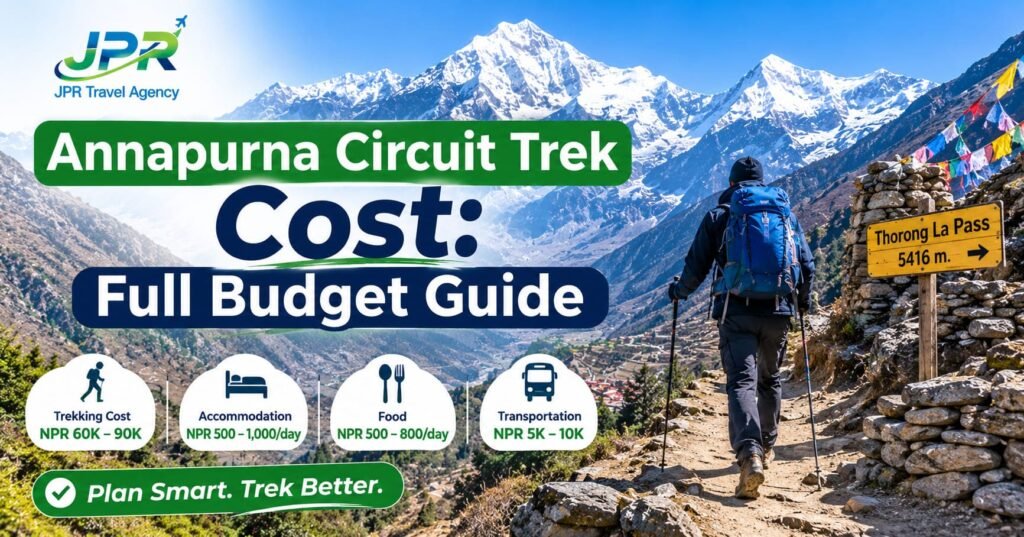
For most international travellers, the estimated annapurna circuit trek cost in 2027 ranges from USD 950 to USD 2,200 per person (approximately NPR 142,500 to NPR 330,000) for a standard 12-to-16-day itinerary, excluding international airfare. Your final expenditure depends on your trek duration, travel style, ground or air transportation, teahouse category, daily meal choices, official permits, and how you arrange licensed guide and porter support. Because official 2027 seasonal tariffs are finalised closer to departure, all figures in this guide are realistic planning estimates for the 2027 spring (March–May) and autumn (September–November) trekking seasons, based on verified rates as of November 2026 and the Nepal Rastra Bank exchange rate of roughly NPR 150 = USD 1.
How Much Does the Annapurna Circuit Trek Cost in 2027?
Whether you arrange logistics on the ground with a local guide or book an all-inclusive itinerary, understanding how each travel tier structures expenses helps you build an accurate Annapurna Circuit budget.
| Trekking Style (12 to 16 Days) | Estimated 2027 Cost per Person |
|---|---|
| Budget / Pay-As-You-Go Trek | USD 950 – USD 1,250 (NPR 142,500 – NPR 187,500) |
| StandardGuided Package Trek | USD 1,300 – USD 1,650 (NPR 195,000 – NPR 247,500) |
| Comfort / Private Organised Package | USD 1,750 – USD 2,300+ (NPR 262,500 – NPR 345,000+) |
- Budget / Pay-As-You-Go Trek: Assumes two or more trekkers splitting the daily rate of a mandatory licensed guide, travelling by local buses and shared 4WD jeeps, staying in basic twin-share teahouses, and eating local meals like dal bhat. Includes permits, shared guide fees, basic rooms, three daily meals, and public transport. Excludes Nepal visa fees, travel insurance, porter hire, equipment rentals, hot showers, Wi-Fi, and tips.
- Standard Guided Package Trek: The most popular option booked through a registered Nepal agency. You can review a full day-by-day Annapurna Circuit Trek itinerary and package overview to see how standard logistics are arranged. Includes official permits, a licensed English-speaking guide, shared porter service (one porter per two trekkers), three daily teahouse meals with hot drinks, standard lodge rooms, and scheduled overland transfers. Excludes international flights, personal bar or snack bills, travel insurance, and staff gratuities.
- Comfort / Private Organised Package: Designed for trekkers seeking private 4WD jeep transfers, a dedicated private guide and porter, upgraded en-suite lodges where available (such as in Manang, Jomsom, and Pokhara), and a one-way domestic flight from Jomsom to Pokhara. Excludes international airfare, high-altitude insurance, and personal tips.
Annapurna Circuit Trek Cost Breakdown
 Breaking down individual trekking expenses in Nepal clarifies where your money goes before and during the journey.
Permits and Entry Fees
Compared to restricted-area routes such as the Manaslu Circuit Trek, Annapurna trekking permits are straightforward and affordable:
- Annapurna Conservation Area Permit (ACAP): Required for every trekker entering the conservation zone. Managed by the National Trust for Nature Conservation (NTNC), the official fee is NPR 3,000 (approx. USD 20)for foreign nationals and NPR 1,000 (approx. USD 6.65) for SAARC nationals. Children under 10 are exempt.
- TIMS Card and Guide Regulations: Following Nepal Tourism Board regulatory updates introduced in April 2023, foreign trekkers are required to trek with a licensed guide hired through a registered agency. While the Trekkers’ Information Management System (TIMS) card—priced at NPR 2,000 (approx. USD 13.30) for individual applicants and NPR 1,000 (approx. USD 6.65) for agency-organised groups—has seen inconsistent checkpoint enforcement in the Annapurna region compared to ACAP, many agencies still issue both documents to ensure seamless checkpoint registration. Budgeting NPR 3,000 to NPR 5,000 (USD 20–34) covers all trail permit requirements.
- Nepal Tourist Visa: Issued on arrival by the Department of Immigration at Tribhuvan International Airport or via pre-arrival online application. Official fees are USD 30 for 15 days, USD 50 for 30 days, and USD 125 for 90 days. Most circuit trekkers need the 30-day visa.
Transportation Costs
Road construction in the Marshyangdi and Kali Gandaki valleys gives trekkers flexible entry and exit options:
- Kathmandu to Besisahar and Trailhead (Dharapani/Chame): A local or tourist bus from Kathmandu to Besisahar costs NPR 1,000–1,800 (USD 7–12). From Besisahar, a shared 4WD jeep over rough mountain roads to Chame or Dharapani costs NPR 2,500–4,500 (USD 17–30) per passenger. Hiring a private jeep from Kathmandu to Dharapani costs roughly USD 180–250 per vehicle.
- Muktinath / Jomsom to Pokhara: After crossing Thorong La Pass, a shared jeep or bus from Muktinath or Jomsom to Pokhara costs NPR 2,500–4,500 (USD 17–30). Alternatively, a 20-minute domestic flight from Jomsom to Pokhara costs USD 115–150 one-way for foreign nationals, followed by a tourist bus (USD 10–25) or domestic flight (USD 105–125) back to Kathmandu.
Accommodation and Food
Teahouse rates follow a community-regulated model where lodging is inexpensive provided you eat dinner and breakfast at the same lodge:
- Teahouse Accommodation: Basic twin rooms cost NPR 750–1,500 (USD 5–10) per night in lower villages, rising to NPR 1,500–3,000 (USD 10–20) at high-altitude stops like Yak Kharka and Thorong Phedi. Upgraded rooms with attached bathrooms in Manang or Jomsom range from USD 20 to USD 40 per night.
- Daily Meals and Water: Expect to spend USD 25–35 (NPR 3,750–5,250) per day on three meals and hot beverages. A filling plate of dal bhat (lentil soup, rice, and vegetable curry with free refills) costs NPR 800–1,500 (USD 5.30–10) depending on elevation. Boiled or bottled drinking water costs NPR 100–400 (USD 0.65–2.70) per litre as you climb higher.
Guide and Porter Costs
Hiring qualified support staff is both a regulatory standard and a vital safety measure when crossing high passes:
- Licensed Trekking Guide: USD 30–40 (NPR 4,500–6,000) per day, totalling USD 420–560 for a 14-day trek. This rate covers the guide’s daily wages, food, lodge accommodation, and insurance.
- Trekking Porter: USD 20–30 (NPR 3,000–4,500) per day, or USD 280–420 over 14 days. One porter typically carries up to 20 kg of combined luggage for two trekkers.
Equipment, Insurance, and Other Expenses
Personal preparation and trail extras account for the remainder of the annapurna circuit trekking cost:
- Trekking Gear Rentals: If you do not own four-season gear, renting a quality sleeping bag and down jacket in Kathmandu or Pokhara costs NPR 200–350 (USD 1.35–2.35) per item per day, or roughly USD 40–80 for the trip.
- High-Altitude Travel Insurance: Mandatory for trekking packages and essential for safety. A policy covering trekking up to 5,500–6,000 metres and emergency helicopter evacuation typically costs USD 120–250. Read our altitude sickness guide to understand why proper acclimatisation and evacuation coverage are non-negotiable around Thorong La Pass (5,416 m).
- Trail Extras, Tips, and Contingency: Budget NPR 300–800 (USD 2–5.30) each for hot showers, Wi-Fi access, and device charging at high camps, plus USD 100–200 for customary guide and porter tips and USD 150–200 in cash as an emergency buffer.
What Makes the Annapurna Circuit Trek More Expensive?
Several factors can push your spending toward the upper end of the range:
- Extended Itineraries: Adding a two-to-three-day side trip to Tilicho Lake (4,919 m) or extending the route via Ghorepani and Poon Hill adds extra days of food, lodging, and staff wages.
- High-Altitude Supply Logistics: Above Chame and Pisang, supplies are transported by mule trains or porters, causing menu prices at Thorong Phedi and High Camp to run 50% to 100% higher than in lower valleys.
- Solo Private Staffing: Bearing the full daily cost of a private guide, porter, and 4WD jeep transfer alone costs substantially more than splitting those fixed expenses across two to four people.
- Purchasing Brand-New Gear: Buying a new technical shell, four-season sleeping bag, and trekking boots for a single trip can easily add USD 500–1,000 before you arrive in Nepal.
- Last-Minute Flights and Weather Delays: Choosing the Jomsom–Pokhara flight or experiencing high-wind delays that require private jeep re-bookings increases transport outlays.
- Peak-Season Demand: Trekking during October–November or April reduces room for negotiation on transport and private lodge upgrades.
- Unforeseen Medical Needs: Extra acclimatisation nights or emergency descent transport can add unplanned daily expenses.
How to Reduce Your Annapurna Circuit Trek Cost in 2027
You can lower your Annapurna Circuit package cost or daily trail spending responsibly without compromising safety:
- Use Shared Overland Transport: Book public buses to Besisahar and shared local jeeps to Dharapani and from Muktinath to Pokhara instead of private vehicles or domestic flights.
- Rent Heavy Cold-Weather Gear: Rent down jackets, sleeping bags, and crampons or microspikes in Thamel (Kathmandu) or Lakeside (Pokhara) rather than buying expensive equipment for one trek.
- Purify Your Own Drinking Water: Bring a reusable bottle paired with water purification tablets or a portable filter to save USD 30–50 on boiled water and prevent plastic waste.
- Pack Trail Snacks from the City: Buy nuts, energy bars, and electrolyte powder in Kathmandu or Pokhara, where prices are a fraction of high-altitude teahouse rates.
- Eat Fresh Local Meals: Choosing dal bhat for lunch or dinner provides free refills and sustained energy at a lower cost than imported pasta, pizza, or bakery items.
- Trek in a Small Group: Partnering with one to three fellow trekkers splits guide, porter, and jeep fees while fully complying with Nepal’s trekking regulations. (If your budget or timeframe is tighter, you might also consider shorter routes like the Langtang Valley Trek.)
- Never Cut Safety Essentials: Never attempt to save money by bypassing ACAP checkpoints, skipping acclimatisation days in Manang, trekking without a licensed guide, or purchasing budget insurance that excludes helicopter rescue above 5,000 metres.
Is the Annapurna Circuit Trek Worth the Cost?
Among the routes considered the best trekking in Nepal, the Annapurna Circuit delivers exceptional value per dollar spent. Over roughly two weeks, the trail transitions from lush subtropical terraced fields and waterfalls to the arid Tibetan-influenced plateau of Manang and Mustang, culminating in the crossing of Thorong La Pass (5,416 m) surrounded by Annapurna I, II, III, IV, Dhaulagiri, and Gangapurna. Because community teahouses are well established along the entire loop, trekkers enjoy warm beds and hot meals without paying for expensive expedition-style camping or restricted-area permits.
If you want a transparent, customised quote or help matching your 2027 schedule and budget to the right itinerary, contact JPR Travel Agency to plan your trek with experienced local specialists.
Frequently Asked Questions
1. How much does the Annapurna Circuit Trek cost in 2027?
For a typical 12-to-16-day itinerary in 2027, budget between USD 950 and USD 1,250 for a shared budget trek, USD 1,300 to USD 1,650 for a standard all-inclusive guided package, and USD 1,750 to USD 2,300+ for a private comfort package with flights and upgraded lodges.
2. What is the cheapest way to do the Annapurna Circuit Trek?
The most economical legal way to trek is to travel with 2–4 people to split the daily cost of a licensed guide and porter, use public buses and shared 4WD jeeps instead of flights, purify your own water, and eat local dal bhat at teahouses.
3. How much money should I carry for the Annapurna Circuit Trek?
ATMs in Besisahar, Chame, Manang, and Jomsom are unreliable and frequently run out of cash. If you are on a pre-paid package, carry NPR 35,000–55,000 (USD 230–365) in cash for snacks, hot showers, charging, Wi-Fi, tips, and emergencies. Pay-as-you-go trekkers should carry NPR 75,000–105,000 (USD 500–700) in Nepali Rupees.
4. Are permits included in Annapurna Circuit Trek packages?
Yes. Almost all standard and private packages booked through registered agencies include the Annapurna Conservation Area Permit (ACAP) and any applicable TIMS registration fees. Always confirm permit inclusion in writing before paying a deposit.
5. Is hiring a guide compulsory for the Annapurna Circuit Trek?
Under Nepal Tourism Board regulations implemented in April 2023, foreign trekkers are required to be accompanied by a licensed trekking guide arranged through a registered agency when trekking in the Annapurna Conservation Area.
6. How much do food and accommodation cost on the Annapurna Circuit?
Basic teahouse rooms cost USD 5–10 per night at lower elevations and USD 10–20 at higher altitudes. Expect to spend USD 25–35 per day on three meals and hot drinks, with prices increasing as you approach Thorong La Pass.
7. How many days are needed to complete the Annapurna Circuit Trek?
Most trekkers complete the modern route (driving to Dharapani or Chame and exiting from Muktinath or Jomsom) in 12 to 15 days, including an essential acclimatisation day in Manang. Adding Tilicho Lake extends the trek to 15 to 18 days.