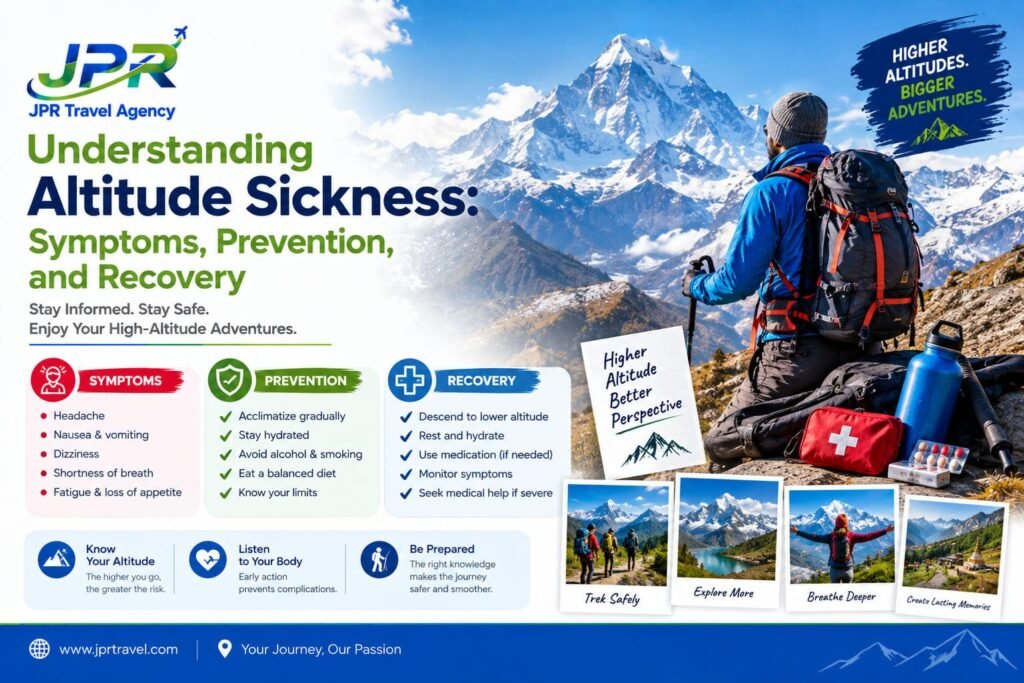
Planning a trek in Nepal, Peru, Tanzania, the Himalayas, or another high-altitude destination can be an unforgettable experience. But as you climb higher, the air contains less available oxygen, and your body needs time to adapt.
This is where altitude sickness becomes an important concern for travelers.
Altitude sickness is a group of health problems that can occur when someone ascends to high elevation too quickly. The most common form is acute mountain sickness (AMS). In rare cases, altitude illness can become much more serious and develop into high-altitude cerebral edema (HACE) or high-altitude pulmonary edema (HAPE).
The good news is that altitude sickness is often preventable. Gradual ascent, proper acclimatization, recognizing early symptoms, and knowing when to stop ascending or descend can significantly reduce the risk.
This guide explains altitude sickness symptoms, prevention, acclimatization, treatment, medication, and high-altitude safety tips, with practical information for international travelers planning trekking holidays in Nepal.
Medical note: This article is for travel education and should not replace advice from a qualified doctor or travel-medicine professional. Travelers with significant heart, lung, neurological, or other medical conditions should discuss high-altitude travel with a healthcare professional before departure.
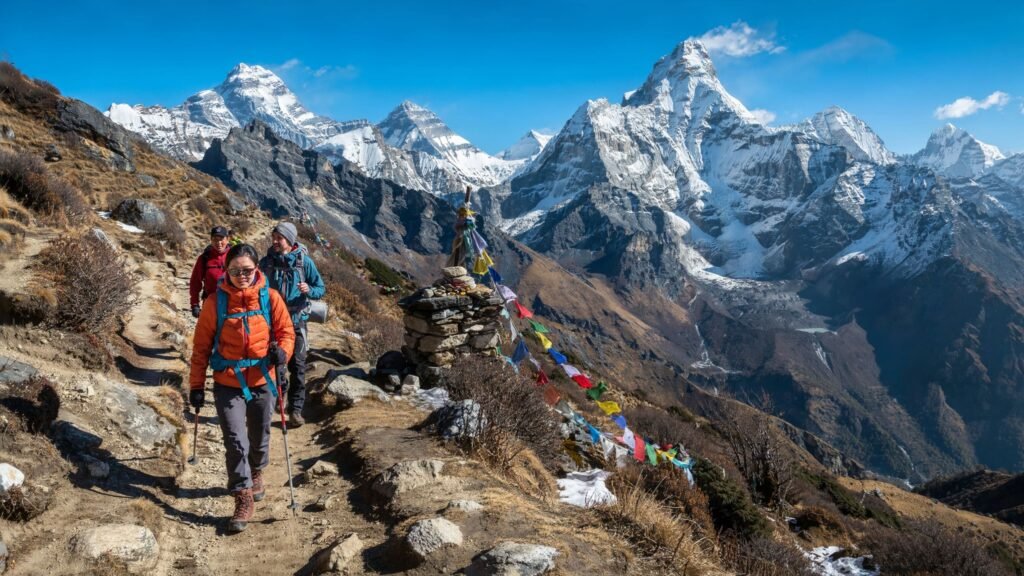
What Is Altitude Sickness?
Altitude sickness, also called altitude illness, occurs when the body does not have enough time to adapt to the lower oxygen availability at higher elevations.
The risk generally becomes more significant above about 2,500 metres (8,200 feet), although altitude illness can sometimes occur at lower elevations. Your risk depends largely on how high you go, how quickly you ascend, your previous experience at similar elevations, and individual susceptibility.
The body begins responding to high altitude by increasing breathing and making other physiological adjustments. This process is called acclimatization and takes time.
For travelers, the biggest mistake is often going “too high too fast.”
For example, flying or driving rapidly from a low elevation to a high sleeping altitude can leave the body with little time to adapt. This is especially relevant for trekking routes in Nepal, where travelers can gain elevation significantly within a few days.
The CDC recommends gradual ascent and notes that once above approximately 3,000 metres, travelers should generally avoid increasing sleeping altitude by more than about 500 metres per day, with additional acclimatization days during larger elevation gains.
What Causes Altitude Sickness?
At higher elevations, atmospheric pressure decreases. This means each breath delivers less oxygen to your lungs than it would at sea level.
Your body needs time to compensate for this change.
Several factors can increase the likelihood of altitude sickness:
Ascending too quickly
Sleeping at a high altitude soon after arriving from a low elevation
Gaining sleeping altitude too rapidly
Previous history of altitude sickness
Traveling to elevations above approximately 2,500 metres without acclimatization
Continuing to climb despite developing symptoms
Heavy physical exertion shortly after reaching a high altitude
Importantly, fitness does not make you immune to altitude sickness. Even extremely fit and experienced trekkers can develop AMS.
Who Is at Risk of Altitude Sickness?
Almost anyone who is not acclimatized can develop altitude illness.
Risk varies considerably from person to person, so being young, fit, or an experienced traveler does not guarantee protection.
Someone who has previously experienced altitude sickness at a similar altitude and rate of ascent may have a better indication of their personal risk, but previous success at high altitude does not completely eliminate the possibility of becoming sick on another trip.
Children can also experience altitude sickness, and people with certain medical conditions may require additional precautions.
Before a high-altitude trip, consider speaking with a travel-medicine doctor if you have:
Heart or lung disease
A neurological condition
Severe anemia
Previous serious altitude illness
Concerns about medications at high altitude
A planned itinerary involving rapid ascent to extreme elevation
Altitude Sickness Symptoms
Recognizing the early symptoms of altitude sickness is one of the most important parts of staying safe.
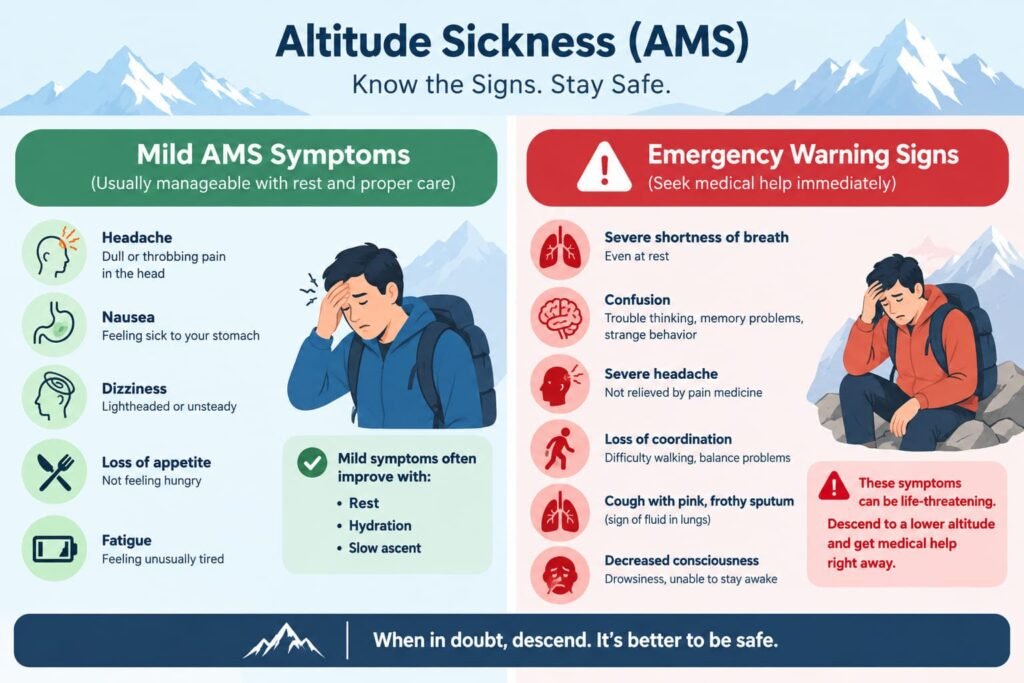
Common Symptoms of Acute Mountain Sickness (AMS)
Symptoms of mild AMS commonly develop within several hours after reaching a higher altitude and can include:
Headache
Dizziness or lightheadedness
Tiredness or unusual fatigue
Loss of appetite
Nausea
Vomiting
Difficulty sleeping
Reduced ability to exercise normally
A headache combined with one or more other typical symptoms after ascending is particularly important to pay attention to.
Symptoms often improve after resting and acclimatizing, but they should never be ignored if they are getting worse.
The NHS notes that altitude sickness symptoms commonly improve within 1 to 3 days when a person rests at the same altitude and does not continue climbing.
Severe Altitude Sickness Symptoms
More serious symptoms may indicate a dangerous form of altitude illness.
Watch for:
Severe or worsening headache
Confusion
Difficulty walking or maintaining balance
Unusual behavior
Extreme drowsiness
Shortness of breath while resting
Persistent or worsening cough
Frothy or bloody sputum
Blue or grey lips or skin
Significant weakness
Reduced consciousness
These symptoms can indicate HACE or HAPE, which are medical emergencies.
The Three Main Types of Altitude Illness
Altitude illness is commonly discussed in three forms.
1. Acute Mountain Sickness (AMS)
AMS is the most common form of altitude illness.
Typical symptoms include headache, nausea, fatigue, dizziness, poor appetite, and sleep disturbance after ascending to altitude.
Mild AMS does not necessarily mean you must immediately descend, but it does mean you should stop gaining elevation and monitor your condition carefully.
Do not continue ascending simply because you have a planned itinerary.
2. High-Altitude Cerebral Edema (HACE)
High-altitude cerebral edema (HACE) is a severe and potentially life-threatening form of altitude illness involving swelling of the brain.
Important warning signs include:
Confusion
Severe difficulty walking
Loss of coordination
Altered mental status
Extreme drowsiness
Reduced consciousness
Suspected HACE requires urgent treatment and descent to a lower altitude, together with oxygen and medication when available.
3. High-Altitude Pulmonary Edema (HAPE)
High-altitude pulmonary edema (HAPE) occurs when fluid accumulates in the lungs.
Warning signs include:
Shortness of breath at rest
Persistent cough
Chest tightness or congestion
Markedly reduced exercise ability
Rapid breathing
Bluish or grey discoloration
Frothy or bloody sputum in advanced cases
HAPE is a medical emergency. The priority is urgent descent, with supplemental oxygen and appropriate medical treatment where available.
How to Prevent Altitude Sickness
The best treatment for altitude sickness is prevention.
You cannot completely eliminate your risk, but good altitude acclimatization can greatly improve your chances of having a safe and enjoyable trek.
1. Ascend Gradually
The single most important strategy is to avoid gaining elevation too quickly.
Once you are above approximately 3,000 metres (9,800 feet), a commonly recommended approach is to limit the increase in sleeping altitude to around 500 metres per day and include additional acclimatization days as elevation increases.
2. Take Acclimatization Days
An acclimatization day is not necessarily a day of doing nothing.
Many trekking itineraries use the concept of “climb high, sleep low.” You may hike to a higher elevation during the day and return to a lower elevation to sleep.
This gives your body exposure to higher altitude while reducing the amount of elevation gained overnight.
For routes such as Everest Base Camp, acclimatization days are an important part of the itinerary rather than simply extra vacation days.
3. Do Not Continue Climbing With Symptoms
One of the most important rules of high-altitude trekking is:
Do not ascend to a higher sleeping altitude while you have symptoms of AMS.
Rest at your current elevation and monitor your condition.
If symptoms improve, your trekking team may decide it is safe to continue according to the planned acclimatization schedule. If symptoms worsen or fail to improve, descent may be necessary.
The NHS recommends descending approximately 300–1,000 metres when symptoms are worsening or not improving.
4. Avoid Alcohol During Early Acclimatization
Alcohol can interfere with sleep and acclimatization and can make it more difficult to recognize or manage symptoms.
The CDC recommends avoiding alcohol during the first 48 hours at high altitude.
5. Stay Normally Hydrated
Drink fluids regularly, especially while hiking, but avoid excessive water consumption.
Dehydration can make you feel worse, but forcing large quantities of water does not prevent altitude sickness and may create other problems.
A practical approach is to drink according to thirst and maintain normal hydration.
6. Keep Your First Days Easy
Do not treat the first day at altitude like a fitness challenge.
Heavy exertion immediately after gaining significant elevation can make symptoms more difficult to recognize and may leave you unnecessarily exhausted.
Keeping activity relatively moderate during the first 24–48 hours can help you adjust.
7. Sleep at the Appropriate Altitude
Your sleeping altitude is particularly important because the body is exposed to reduced oxygen for many hours while you sleep.
A well-designed trekking itinerary therefore focuses not only on the highest point reached during the day but also on how quickly your sleeping elevation increases.
How Long Does It Take to Acclimatize to High Altitude?
Acclimatization begins relatively quickly after reaching high altitude.
The most important early acclimatization changes occur during approximately the first 3–5 days, although adaptation can continue for weeks or longer.
This is why gradual itineraries are safer than suddenly traveling from sea level to an extremely high sleeping altitude.
There is no single number of days that guarantees you will not develop altitude sickness. Individual responses vary, and symptoms can still develop after successful acclimatization if you move significantly higher.
Altitude Sickness Medication
Some travelers may benefit from medication for altitude sickness, particularly when a rapid ascent is unavoidable or when their risk is considered moderate or high.
Acetazolamide (Diamox)
Acetazolamide, commonly known by the brand name Diamox, is the most frequently discussed medication for preventing acute mountain sickness.
It works by helping the body acclimatize more quickly and is generally most effective when started before or around the beginning of ascent according to medical advice.
The CDC lists 125 mg twice daily as a commonly recommended adult prophylactic dose, with dosing considerations depending on circumstances.
However, medication is not appropriate for everyone.
Potential side effects include tingling sensations, increased urination, and other effects. Drug interactions, allergies, pregnancy, kidney problems, and individual medical history should be considered.
Speak with a qualified healthcare professional before using acetazolamide.
Dexamethasone
Dexamethasone can prevent and treat AMS and is particularly useful in certain emergency situations.
Unlike acetazolamide, it does not accelerate the underlying acclimatization process in the same way. It may therefore be used differently depending on the situation.
Dexamethasone should be used under appropriate medical guidance, particularly because symptoms can return after it is discontinued if the person has not acclimatized.
Can Ibuprofen Prevent Altitude Sickness?
Research has shown that ibuprofen can reduce the risk of AMS and may be useful in some travelers.
However, it is not a substitute for gradual ascent and proper acclimatization, and it may not be suitable for people with certain medical conditions.
Ask a doctor or pharmacist whether it is appropriate for you.
What to Do If You Get Altitude Sickness
Your response should depend on the severity of your symptoms.
For Mild AMS
If you develop mild symptoms:
Stop ascending.
Rest at your current elevation and tell your trekking guide, travel companion, or group leader.
Pain medication or anti-nausea medication may help relieve individual symptoms when appropriate.
Monitor yourself closely.
If symptoms improve, you may be able to continue after adequate acclimatization. However, never use symptom-relieving medication as a reason to ignore worsening symptoms and continue climbing.
If Symptoms Get Worse
If symptoms are getting worse despite resting, or they do not improve, descend to a lower altitude.
Do not wait for severe symptoms to appear.
A rapid and safe descent is one of the most effective treatments for serious altitude illness.
For Severe Symptoms
Confusion, loss of coordination, difficulty walking, severe breathlessness at rest, or signs of fluid in the lungs should be treated as an emergency.
The person should descend immediately when possible and receive oxygen and medical treatment.
In remote environments, portable oxygen or a portable hyperbaric chamber can sometimes be used as temporary measures when descent is delayed, but these should not replace evacuation or definitive medical care.
[IMAGE 3 – ALTITUDE SAFETY / DESCENT IMAGE]
Suggested image: Trekker descending a Himalayan trail with a guide.
Suggested ALT text: “Trekker descending to lower altitude after developing altitude sickness symptoms”
Placement: After the treatment section.
Altitude Sickness and Nepal Trekking
Nepal is one of the world’s most popular destinations for high-altitude trekking.
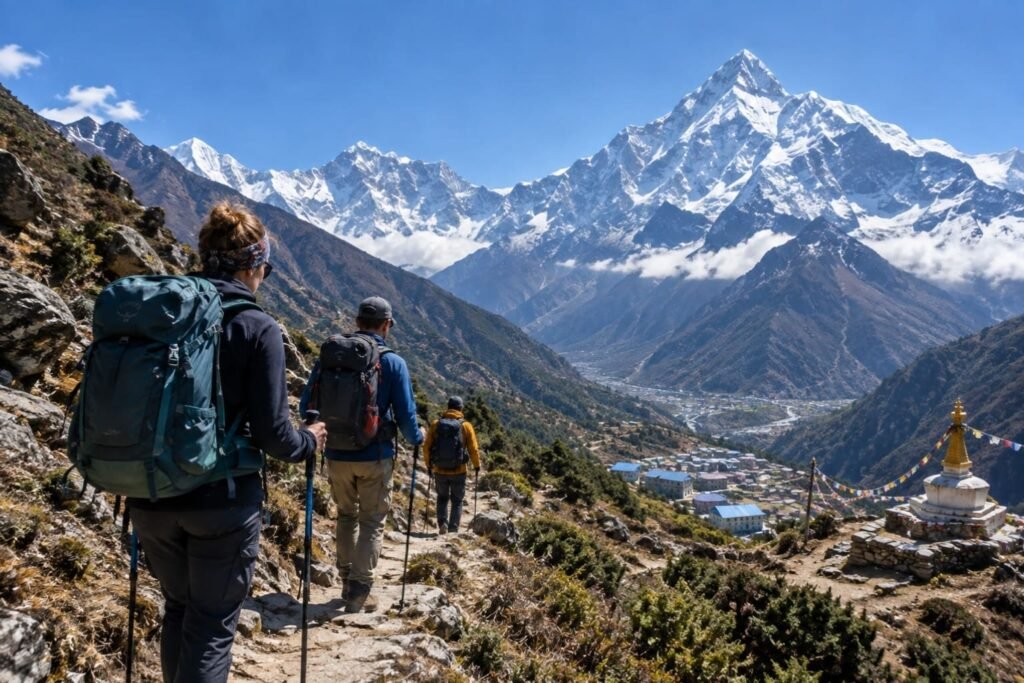
Routes such as Everest Base Camp, Manaslu Circuit, Annapurna Circuit, and other Himalayan treks include substantial elevation changes, making acclimatization an essential part of trip planning.
Everest Base Camp
Everest Base Camp sits at approximately 5,400 metres (17,700 feet), making altitude management particularly important.
The journey should therefore be planned around gradual elevation gain, acclimatization days, and conservative pacing rather than simply reaching base camp as quickly as possible.
You can read our detailed Everest Base Camp Trek Guide when planning your route.
The CDC specifically identifies Everest Base Camp as a high-altitude destination where altitude illness can be a significant concern.
Manaslu Circuit
The Manaslu Circuit Trek reaches high elevations, particularly around the Larkya La area.
Travelers should carefully consider acclimatization and avoid treating the itinerary as a race.
Read our Manaslu Circuit Trek guide for route-planning information.
Annapurna Circuit
The Annapurna Circuit Trek also involves substantial elevation gain and reaches high mountain passes.
A carefully planned itinerary is important, particularly for travelers arriving from low elevations.
See our Annapurna Circuit Trek page for more information.
Langtang Valley Trek
The Langtang Valley Trek reaches higher elevations than many casual hiking routes in Nepal.
Although it is often considered accessible compared with some longer Himalayan expeditions, travelers should still understand altitude sickness symptoms and know when to stop ascending.
Makalu and Other High-Altitude Routes
More demanding routes such as the Makalu Base Camp Trek involve extended exposure to high elevation.
The more remote the route, the more important it is to have a realistic itinerary, appropriate equipment, experienced guides, communication arrangements, and a plan for evacuation or descent.
Does Being Fit Prevent Altitude Sickness?
No.
Physical fitness can help you cope with the physical demands of trekking, but it does not prevent altitude sickness.
A highly athletic traveler can still develop AMS, while someone with average fitness may acclimatize successfully.
Altitude illness is influenced more strongly by elevation, rate of ascent, previous response to altitude, and individual susceptibility than by cardiovascular fitness alone.
Does Drinking More Water Prevent Altitude Sickness?
No.
Maintaining normal hydration is important during trekking, particularly in cold, dry, physically demanding environments, but drinking excessive amounts of water does not prevent AMS.
The goal should be normal hydration rather than forced hydration.
Overhydration can also create medical problems, so do not force yourself to drink very large quantities simply because you are trekking at altitude.
Can You Get Altitude Sickness at Lower Elevations?
Yes.
Altitude sickness is usually associated with elevations above approximately 2,500 metres, but symptoms can sometimes occur at lower elevations.
Individual susceptibility varies considerably.
A traveler should therefore pay attention to how they feel rather than assuming they are completely safe because they have not yet reached a particular elevation.
Altitude Sickness Safety Checklist for Travelers
Before starting a high-altitude trek, make sure you understand the following:
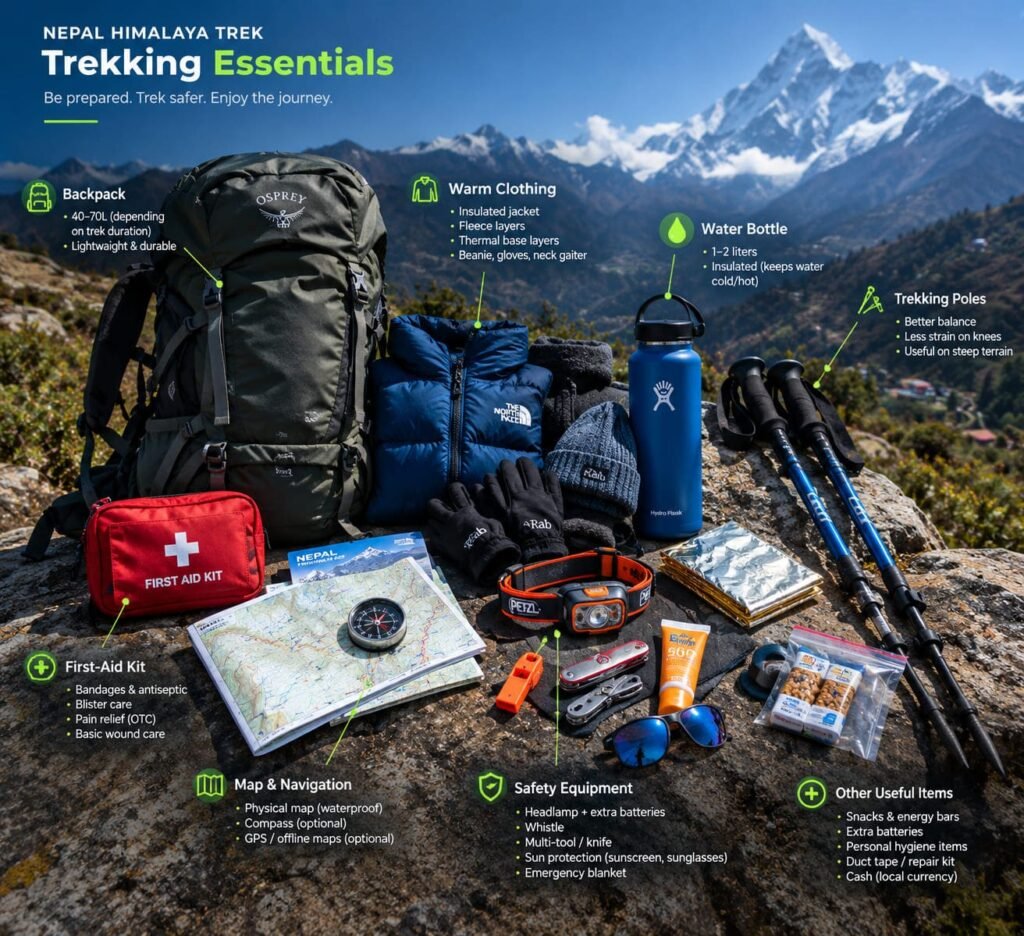
Know your itinerary: Check the sleeping altitude for every major trekking day.
Plan acclimatization: Avoid rapid increases in sleeping altitude.
Recognize AMS: Headache, nausea, fatigue, dizziness, appetite loss, and sleep problems can be warning signs.
Stop ascending when symptomatic: Never use a fixed itinerary as a reason to push through worsening symptoms.
Know emergency signs: Confusion, coordination problems, severe breathlessness at rest, or frothy/bloody sputum require urgent action.
Tell your guide: Do not hide symptoms because you are worried about delaying your group.
Have a descent plan: Remote mountain routes require realistic emergency planning.
Discuss medication beforehand: Ask a qualified healthcare professional whether acetazolamide or another medication is appropriate for you.
Travel with suitable insurance: For high-altitude trekking, check whether your travel insurance covers trekking at the maximum altitude on your itinerary and emergency evacuation.
When Should You Descend?
One of the most important rules of altitude safety is knowing when descent is necessary.
For mild AMS, stopping further ascent and resting may be enough.
But worsening symptoms require a lower altitude.
Immediate descent is particularly important when there are signs of HACE or HAPE, including:
Confusion or altered mental status
Inability to walk normally
Severe loss of coordination
Shortness of breath while resting
Persistent severe cough
Frothy or bloody sputum
Reduced consciousness
Do not wait for symptoms to become extreme before seeking help.
In high-altitude environments, descent can be lifesaving.
Frequently Asked Questions About Altitude Sickness
1. What are the first symptoms of altitude sickness?
The most common early symptoms are headache, tiredness, dizziness, nausea, reduced appetite, and difficulty sleeping. Symptoms often appear several hours after reaching a higher altitude.
2. At what altitude does altitude sickness start?
The risk generally becomes more significant above around 2,500 metres (8,200 feet), although altitude illness can occur lower than this in some people.
3. How can I prevent altitude sickness?
The most effective prevention strategy is gradual ascent and proper acclimatization. Avoid increasing your sleeping altitude too quickly, take acclimatization days, avoid heavy exertion immediately after ascending, and do not continue climbing when you have worsening symptoms.
4. How long does altitude sickness last?
Mild AMS often improves within 1–3 days when a traveler rests at the same elevation and does not continue ascending. More serious illness requires prompt medical attention and potentially immediate descent.
5. Should I take Diamox for altitude sickness?
Acetazolamide (Diamox) can help prevent and treat AMS and may be recommended for travelers at increased risk. Whether you should take it depends on your itinerary, medical history, medications, and contraindications, so discuss it with a qualified healthcare professional before your trip.
6. What should I do if I get altitude sickness while trekking?
Stop ascending and tell your trekking guide or travel companion. For mild symptoms, rest and monitor your condition. If symptoms worsen or fail to improve, descend. Severe symptoms such as confusion, loss of coordination, or shortness of breath at rest require urgent descent and medical treatment.
7. Can I get altitude sickness even if I am physically fit?
Yes. Fitness does not prevent altitude sickness. Even experienced and highly fit trekkers can develop AMS if they ascend too rapidly or are individually susceptible.
Final Takeaway: Respect the Altitude
Altitude sickness should not stop you from experiencing the world’s great mountain destinations, but it should be taken seriously.
For international travelers trekking in Nepal, the safest approach is to ascend gradually, acclimatize properly, monitor your symptoms, communicate with your guide, and descend when necessary.
Do not compare your pace with another trekker. Two travelers following the same itinerary can respond very differently to altitude.
A successful high-altitude trek is not about reaching the highest point as quickly as possible. It is about giving your body enough time to adapt so that you can enjoy the mountains safely.
Planning an Everest Base Camp, Manaslu, Annapurna, Langtang, or another Nepal trekking adventure? Explore our Nepal Trekking services and route guides to plan your Himalayan journey.