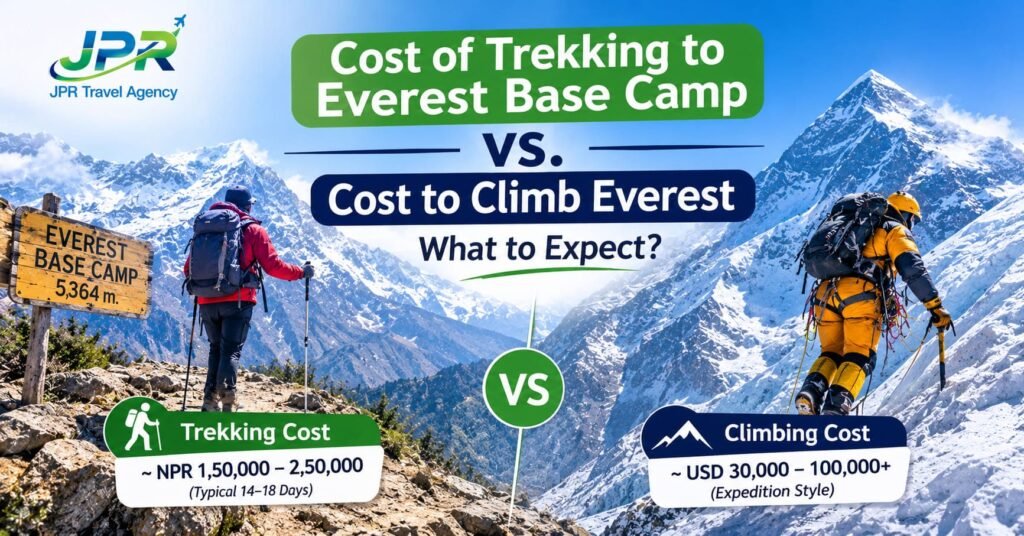
First-time visitors researching Nepal often ask about the cost to climb Everest Base Camp, assuming that reaching the foot of the world’s highest mountain requires ropes, ice axes, and a mountaineering expedition. In reality, you do not “climb” Everest Base Camp—you trek to it along well-established mountain trails. Climbing Mount Everest, by contrast, means attempting to reach the 8,848.86-metre (29,031.7-foot) summit.
That distinction creates a massive financial gap. As of the 2026 trekking and mountaineering seasons, the cost of trekking to Everest Base Camp typically ranges from USD 1,200 to USD 3,000 per person for a standard two-week guided trek. Attempting to summit Mount Everest is a two-month high-altitude expedition that costs between USD 45,000 and USD 130,000 or more per climber. Understanding where your money goes in each experience will help you plan the right Himalayan adventure for your budget and experience level.
Is Trekking to Everest Base Camp the Same as Climbing Mount Everest?
Trekking to Everest Base Camp and climbing Mount Everest are two completely different activities that share only the same approach trail through the Khumbu Valley.
The Everest Base Camp (EBC) trek is a non-technical, multi-day high-altitude hike that takes 12 to 14 days round-trip from Lukla. Trekkers follow stone paths, suspension bridges, and glacial moraines through Sherpa villages such as Namche Bazaar and Dingboche, sleeping in local teahouses each night. Your goal is South Base Camp at 5,364 metres (17,598 feet) and the nearby viewpoint of Kala Patthar at 5,545 metres (18,192 feet). Once you take your photos at the base of the Khumbu Icefall, you turn around and walk back to Lukla. No mountaineering permit, rope work, or technical climbing experience is required.
A Mount Everest summit expedition begins where the trek ends. After walking to Base Camp, mountaineers spend six to eight weeks living on the glacier, acclimatising through multiple rotations up the treacherous Khumbu Icefall, Western Cwm, and Lhotse Face, and pushing through the “Death Zone” above 8,000 metres using supplemental oxygen and fixed ropes to reach the top of the world.
Cost of Trekking to Everest Base Camp
For most international travellers in 2026, the typical everest base camp trekking cost falls between USD 1,200 and USD 3,000 per person (approximately NPR 180,000 to NPR 450,000 based on the November 2026 exchange rate of roughly USD 1 = NPR 150.16). Luxury lodge treks or itineraries featuring a helicopter return from Gorak Shep range from USD 3,000 to USD 4,800.
Your trekking budget covers six core operational areas:
- Kathmandu–Lukla Transport: Round-trip domestic flights via Kathmandu or Manthali (Ramechhap) cost roughly USD 360 to USD 500 per person for foreign nationals. You can explore flight logistics in our Kathmandu to Lukla flight guide.
- Trekking Permits: Trekkers only need two local entry permits—the Sagarmatha National Park Entry Permit (NPR 3,000 for foreign nationals; NPR 1,500 for SAARC nationals) and the Khumbu Pasang Lhamu Rural Municipality Entry Permit (NPR 3,000). Combined, permits cost NPR 6,000 (approx. USD 40).
- Teahouse Accommodation and Meals: Standard teahouse rooms and three hot meals per day average USD 30 to USD 60 per day, increasing with elevation.
- Guides and Porters: A licensed trekking guide costs roughly USD 25 to USD 40 per day, while a porter carrying up to 20 kg costs USD 20 to USD 30 per day.
- Travel Insurance: High-altitude travel insurance covering emergency helicopter evacuation up to 6,000 metres typically costs USD 100 to USD 300 for a single trip.
- Gear and Personal Extras: Renting a down jacket and sleeping bag in Kathmandu, plus paying for hot showers, Wi-Fi, device charging, and staff tips on the trail, adds USD 250 to USD 500.
These figures exclude international airfare to Kathmandu and your Nepal tourist visa. Rather than repeating every line item here, you can view our complete itemised breakdown in the Everest Base Camp trek cost guide or learn how to reduce your spending in our cheapest Everest Base Camp trek budget guide.
Cost to Climb Mount Everest
Attempting to summit Mount Everest requires a major financial commitment. In 2026, the total cost to climb Mount Everest ranges from USD 45,000 to over USD 130,000 per person (approximately NPR 6.75 million to NPR 19.5 million+). Most commercial expeditions fall into three tiers:
- Nepali-Operated Standard Expeditions: USD 45,000 to USD 55,000
- International Western-Guided Expeditions: USD 65,000 to USD 85,000
- Premium, Private, or Rapid-Ascent Expeditions: USD 95,000 to USD 130,000+
It is essential not to confuse the government permit fee with the full expedition price. Under Nepal’s revised Mountaineering Regulations (effective September 1, 2025, and applicable across all 2026 seasons), the Department of Tourism royalty fee for a foreign climber on the standard South Col route is USD 15,000 per person in the primary Spring season (March–May), USD 7,500 in Autumn, and USD 3,750 in Winter or Monsoon—up from the previous USD 11,000 spring rate.
Beyond that single permit fee, a full summit expedition requires:
- Expedition Operator & Base Camp Logistics: Dining tents, heated communication domes, generators, satellite weather forecasting, high-altitude cooks, and two months of expedition food and fuel.
- Regulatory Deposits & Liaison Fees: A refundable USD 4,000 garbage deposit (shared across the team), Khumbu Icefall route-fixing fees paid to the Sagarmatha Pollution Control Committee (SPCC), a government Liaison Officer’s salary and equipment, and mandatory biodegradable waste bags.
- Sherpa Support & Guides: Under current Nepal regulations, at least one guide is mandatory for every two climbers on peaks above 8,000 metres. Dedicated climbing Sherpas, their salaries, summit bonuses (often USD 1,500 to USD 4,000+), and mandatory government-mandated worker insurance (NPR 1.5 million to NPR 2 million+ / up to USD 14,400 for high-altitude guides) represent a major portion of expedition budgets.
- Supplemental Oxygen: Five to eight cylinders of bottled oxygen per climber (plus bottles for your personal Sherpa), along with specialised masks and regulators, costing USD 3,500 to USD 7,000+.
- Technical High-Altitude Gear: Down suits, 8,000-metre triple mountaineering boots, crampons, harnesses, ice axes, and extreme cold-weather systems often cost USD 6,000 to USD 10,000 out of pocket.
- Rescue & Medical Insurance: Specialist mountaineering evacuation and medical coverage valid up to 8,848.86 metres.
Everest Base Camp Trek vs. Mount Everest Climbing Cost Comparison
The two-column comparison below highlights the practical differences between trekking to Base Camp and climbing to the summit as of late 2026:
| Everest Base Camp Trek (5,364 m) | Mount Everest Summit Climb (8,848.86 m) |
|---|---|
| Activity: Non-technical high-altitude lodge trek | Activity: Full technical 8,000m+ mountaineering expedition |
| Typical Cost (2026): USD 1,200 – USD 3,000 (NPR 180k – 450k) | Typical Cost (2026): USD 45,000 – USD 130,000+ (NPR 6.75M – 19.5M+) |
| Duration: 12 to 14 days | Duration: 55 to 65 days (permit valid up to 55 days) |
| Permits: Park & Municipality fees totaling NPR 6,000 (~USD 40) | Permits: USD 15,000 Spring royalty permit + Icefall & garbage fees |
| Experience Needed: Good fitness; no climbing skills required | Experience Needed: Prior 6,000m–8,000m peaks, ice & crampon mastery |
| Equipment: Layered hiking clothes, trekking boots, sleeping bag | Equipment: 8,000m down suit, triple boots, crampons, ice axe, oxygen |
| Support Team: 1 licensed trekking guide & shared porter | Support Team: Lead guides, personal climbing Sherpas, cooks, doctors |
| Overall Difficulty: Strenuous high-altitude trek | Overall Difficulty: Extreme mountaineering into the Death Zone |
Why Is Climbing Everest So Much More Expensive?
The price gap between a USD 1,800 trek and a USD 65,000 expedition comes down to survival infrastructure in an environment where humans cannot survive indefinitely.
First, trekkers rely on existing village infrastructure—sleeping in family-run teahouses and eating locally prepared meals along the trail. Summit climbers must build a self-contained tent village on a moving glacier at 5,364 metres for nearly two months, plus stock four higher camps up to 7,950 metres (South Col) with tents, fuel, food, and bottled oxygen carried by high-altitude Sherpas or helicopters.
Second, safety and regulatory requirements above Base Camp are strict. Fixing thousands of metres of rope through the shifting Khumbu Icefall and up the Lhotse Face, maintaining Bottled Oxygen reserves for both climbers and support staff, insuring high-altitude workers, and keeping teams on standby through weeks of unpredictable jet-stream weather windows drive expedition costs into the tens of thousands of dollars.
Which Everest Experience Should You Choose?
For 99% of adventure travellers, trekking to Everest Base Camp is the right choice. If you have two to three weeks of holiday time, a budget between USD 1,500 and USD 3,000, and solid cardiovascular fitness, our Everest Base Camp trek guide will walk you through everything required to stand at the foot of Everest safely. Keep in mind that while the EBC trek does not involve technical climbing, walking above 5,000 metres is still physically demanding and requires proper acclimatisation—something we cover in detail in our altitude sickness guide.
Climbing Mount Everest is reserved for seasoned mountaineers who have already summited technical 6,000-metre and 7,000-metre peaks (or another 8,000-metre peak), have two months to spare in April and May, and have the financial resources to invest USD 50,000 or more. If you are looking for other rewarding Himalayan journeys before tackling higher altitudes, explore our guides to the best trekking in Nepal and best adventures in Nepal.
Frequently Asked Questions
1. How much does it cost to trek to Everest Base Camp?
In 2026, the cost of trekking to Everest Base Camp typically ranges from USD 1,200 to USD 3,000 per person (approx. NPR 180,000 to NPR 450,000) for a standard 12-to-14-day guided teahouse trek, excluding international flights. Luxury lodge treks and helicopter-return packages cost between USD 3,000 and USD 4,800.
2. How much does it cost to climb Mount Everest?
A commercial expedition to summit Mount Everest in 2026 costs between USD 45,000 and USD 130,000+ per climber.Nepali-operated expeditions typically start around USD 45,000 to USD 55,000, while international Western-guided expeditions generally cost between USD 65,000 and USD 100,000+.
3. Is trekking to Everest Base Camp the same as climbing Everest?
No. Trekking to Everest Base Camp is a non-technical high-altitude hike to an elevation of 5,364 metres (17,598 feet), where you sleep in local teahouses. Climbing Mount Everest is an extreme, two-month technical mountaineering expedition from Base Camp to the 8,848.86-metre summit.
4. Do you need a climbing permit to trek to Everest Base Camp?
No climbing permit is required for the Everest Base Camp trek. You only need two local entry permits: the Sagarmatha National Park Entry Permit (NPR 3,000) and the Khumbu Pasang Lhamu Rural Municipality Permit (NPR 3,000), totaling NPR 6,000 (approximately USD 40).
5. Why does climbing Mount Everest cost so much?
Climbing Mount Everest requires a USD 15,000 spring government royalty permit, nearly two months of Base Camp and high-camp food and tent infrastructure, bottled oxygen systems, route-fixing fees through the Khumbu Icefall, specialist 8,000-metre gear, and dedicated high-altitude Sherpa guides and support staff.
6. Can beginners trek to Everest Base Camp?
Yes, healthy beginners with good cardiovascular fitness can complete the Everest Base Camp trek. Because the trail requires no technical rope or ice-climbing skills, preparation focuses on regular hiking, stamina training, and choosing an itinerary with proper acclimatisation days.
7. Is Everest Base Camp trekking worth the cost?
Yes. For a fraction of the price of a mountaineering expedition, the Everest Base Camp trek delivers up-close views of Mount Everest, Lhotse, Nuptse, and Ama Dablam, authentic Sherpa hospitality, visits to historic monasteries like Tengboche, and the achievement of standing at the foot of the world’s highest peak.
Planning Your Everest Journey in Nepal
While people frequently confuse the cost of trekking to Everest Base Camp with the price of a full summit expedition, the two experiences sit worlds apart in budget, duration, and risk. Reaching Base Camp gives everyday trekkers an unforgettable front-row seat to Mount Everest for USD 1,200 to USD 3,000, without the USD 45,000+ price tag or extreme hazards of the Death Zone.
Ready to plan your trekking adventure in the Khumbu region? Contact JPR Travel Agency today to speak with our local Nepal specialists and customise an Everest Base Camp itinerary tailored to your schedule and budget.